Way of the Bible Podcast | Episode #230
Foundation for Ages Part 6 — Seven Church Ages in Revelation
Scripture Focus: Revelation 1:19; Revelation 2–3; Revelation 4:1
Nearly two thousand years ago, the resurrected Jesus Christ appeared to the Apostle John on the island of Patmos and instructed him to write seven letters to seven churches in Asia Minor.
These were actual congregations facing persecution, false teaching, spiritual compromise, and declining devotion.
But could their messages also reveal the entire history of the Church?
In Episode #230 of the Way of the Bible podcast, we examine a prophetic interpretation of Revelation chapters 2 and 3 that understands these seven churches as representing seven successive periods of Church history.
Seven Churches, Seven Historical Ages
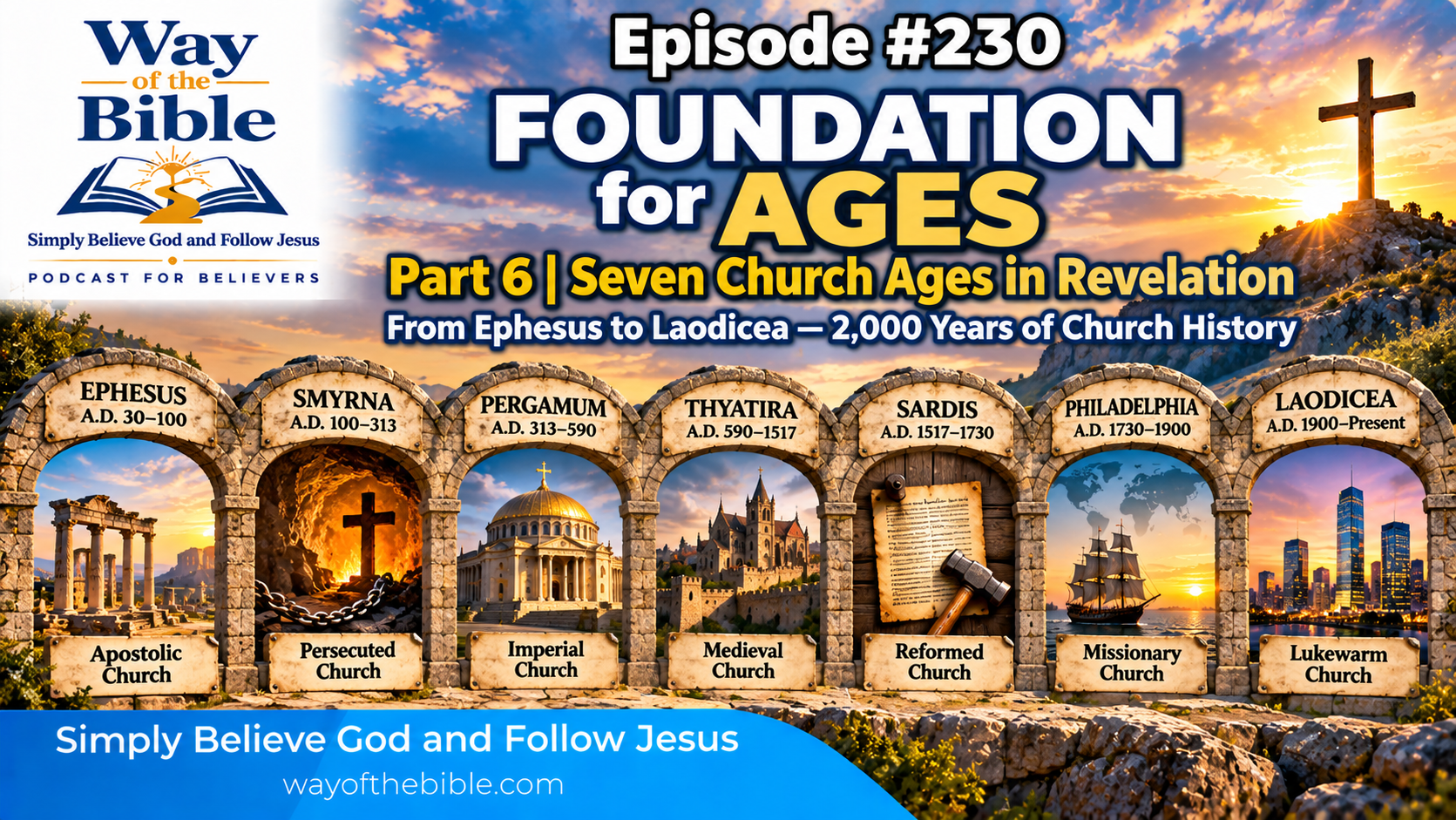
Within this interpretive framework, the seven churches correspond to the following historical periods:
1. Ephesus — The Apostolic Church (AD 30–100)
The Church began with extraordinary evangelistic zeal and doctrinal faithfulness. Yet Jesus warned that the believers had abandoned their first love (Revelation 2:4).
2. Smyrna — The Persecuted Church (AD 100–313)
Christians endured persecution under Roman authorities. Jesus encouraged them to remain faithful even unto death (Revelation 2:10).
3. Pergamum — The Imperial Church (AD 313–590)
Following Constantine’s legalization of Christianity, the Church increasingly acquired political influence. Jesus’ warning about compromise provides a sobering parallel (Revelation 2:13–16).
4. Thyatira — The Medieval Church (AD 590–1517)
This interpretation associates Thyatira with medieval Christianity, emphasizing the dangers of institutional corruption, spiritual compromise, and religious practices that reformers later challenged (Revelation 2:20–22).
5. Sardis — The Reformed Church (AD 1517–1730)
The Protestant Reformation recovered essential biblical teachings, particularly justification by faith. Yet Jesus’ warning about possessing a reputation for life while being spiritually dead invites examination of institutional religion (Revelation 3:1–2).
6. Philadelphia — The Missionary Church (AD 1730–1900)
The Great Awakenings and global missionary expansion characterized this period. Jesus’ promise of an open door and His encouragement to persevere resonate with the missionary movement (Revelation 3:8–10).
7. Laodicea — The Lukewarm Church (AD 1900–Present)
This final age is associated with material prosperity, spiritual complacency, and compromise with worldly values. Jesus confronts a congregation that considers itself wealthy but is spiritually impoverished (Revelation 3:16–20).
What Happens After the Church Age?
Revelation 1:19 instructs John to record what he has seen, what is, and what will happen afterward.
Within the dispensational premillennial interpretation explored in this episode, Revelation 2–3 describes the Church age, while Revelation 4:1 marks a transition toward future prophetic events.
This interpretation also connects the promise to Philadelphia in Revelation 3:10 with the pretribulation Rapture of the Church.
Christians hold differing understandings of these passages, but the central question remains profoundly personal.
Are We Ready?
God declares in Isaiah 46:10 that His purposes will stand.
History does not unfold beyond His sovereignty, nor will His promises fail.
Jesus has been gathering people to Himself throughout the Church age, redeeming men and women from every tribe, language, people, and nation (Revelation 5:9).
And the invitation to salvation remains open.
Whether we are approaching the final moments of the Church age or have more history yet to experience, our calling is unchanged.
Repent. Believe the Gospel. Remain faithful to Jesus Christ.
Simply Believe God and Follow Jesus.
Listen to Episode #230 of the Way of the Bible podcast at WayOfTheBible.com.